'%3e%3cpath%20fill-rule='evenodd'%20clip-rule='evenodd'%20d='M4.78913%2017.7017C3.6351%2020.5765%203%2023.7147%203%2027C3%2038.9548%2011.4092%2048.9609%2022.63%2051.4209C24.36%2051.8001%2026.1568%2052%2028%2052C29.8431%2052%2031.64%2051.8001%2033.37%2051.4209C36.0675%2047.4302%2037.6433%2042.6203%2037.6433%2037.4453C37.6433%2035.4696%2037.4136%2033.547%2036.9795%2031.703C36.2821%2028.7405%2035.0571%2025.9806%2033.4093%2023.5281C34.0408%2024.5209%2034.4067%2025.6988%2034.4067%2026.9616C34.4067%2030.4972%2031.538%2033.368%2028.0033%2033.3715H27.9968H27.9873C24.827%2033.3715%2021.8029%2032.7839%2019.0184%2031.712C12.5509%2029.2223%207.37594%2024.1203%204.78913%2017.7017Z'%20fill='url(%23paint0_linear_331_327)'/%3e%3cpath%20fill-rule='evenodd'%20clip-rule='evenodd'%20d='M7.27324%2013.0244C6.28825%2014.4816%205.45281%2016.0481%204.78906%2017.7016C7.37588%2024.1203%2012.5509%2029.2223%2019.0183%2031.7119C21.8028%2032.7839%2024.8269%2033.3715%2027.9872%2033.3715C24.4538%2033.3664%2021.5867%2030.4961%2021.5867%2026.9616C21.5867%2025.7554%2021.9206%2024.6266%2022.5008%2023.6626C22.6297%2023.4486%2022.7706%2023.2427%2022.9228%2023.0459C24.3454%2021.0318%2026.0581%2019.2369%2027.9999%2017.7223C32.2388%2014.416%2037.5694%2012.4453%2043.3566%2012.4453C45.1998%2012.4453%2046.9966%2012.6452%2048.7266%2013.0244C44.2319%206.375%2036.6228%202%2027.9999%202C19.3771%202%2011.768%206.375%207.27324%2013.0244Z'%20fill='url(%23paint1_linear_331_327)'/%3e%3cpath%20fill-rule='evenodd'%20clip-rule='evenodd'%20d='M33.3699%2051.4209C44.5907%2048.9609%2052.9999%2038.9548%2052.9999%2027.0001C52.9999%2023.7026%2052.3602%2020.5534%2051.1981%2017.67C50.5364%2016.0281%2049.7053%2014.4724%2048.7266%2013.0245C46.9966%2012.6452%2045.1998%2012.4453%2043.3567%2012.4453C37.5694%2012.4453%2032.2388%2014.416%2027.9999%2017.7224C26.0581%2019.237%2024.3454%2021.0318%2022.9229%2023.0459C24.0956%2021.5291%2025.9329%2020.5517%2027.9967%2020.5517C30.1165%2020.5517%2031.9972%2021.5828%2033.1645%2023.1705C33.2499%2023.2868%2033.3316%2023.4061%2033.4092%2023.5281C35.0571%2025.9807%2036.282%2028.7405%2036.9794%2031.703C37.4136%2033.5471%2037.6432%2035.4696%2037.6432%2037.4453C37.6432%2042.6204%2036.0675%2047.4302%2033.3699%2051.4209Z'%20fill='url(%23paint2_linear_331_327)'/%3e%3c/g%3e%3cdefs%3e%3cfilter%20id='filter0_d_331_327'%20x='0'%20y='0'%20width='56'%20height='56'%20filterUnits='userSpaceOnUse'%20color-interpolation-filters='sRGB'%3e%3cfeFlood%20flood-opacity='0'%20result='BackgroundImageFix'/%3e%3cfeColorMatrix%20in='SourceAlpha'%20type='matrix'%20values='0%200%200%200%200%200%200%200%200%200%200%200%200%200%200%200%200%200%20127%200'%20result='hardAlpha'/%3e%3cfeOffset%20dy='1'/%3e%3cfeGaussianBlur%20stdDeviation='1.5'/%3e%3cfeComposite%20in2='hardAlpha'%20operator='out'/%3e%3cfeColorMatrix%20type='matrix'%20values='0%200%200%200%200%200%200%200%200%200%200%200%200%200%200%200%200%200%200.25%200'/%3e%3cfeBlend%20mode='normal'%20in2='BackgroundImageFix'%20result='effect1_dropShadow_331_327'/%3e%3cfeBlend%20mode='normal'%20in='SourceGraphic'%20in2='effect1_dropShadow_331_327'%20result='shape'/%3e%3c/filter%3e%3clinearGradient%20id='paint0_linear_331_327'%20x1='6.57855'%20y1='29.8278'%20x2='34.4067'%20y2='42.0556'%20gradientUnits='userSpaceOnUse'%3e%3cstop%20stop-color='%231E2E41'/%3e%3cstop%20offset='0.5'%20stop-color='%23235B82'/%3e%3cstop%20offset='1'%20stop-color='%23B4ECFF'/%3e%3c/linearGradient%3e%3clinearGradient%20id='paint1_linear_331_327'%20x1='41'%20y1='8'%20x2='13.0644'%20y2='24.2703'%20gradientUnits='userSpaceOnUse'%3e%3cstop%20stop-color='%231E2E41'%20stop-opacity='0.2'/%3e%3cstop%20offset='0.5'%20stop-color='%23235B82'/%3e%3cstop%20offset='1'%20stop-color='%23B4ECFF'/%3e%3c/linearGradient%3e%3clinearGradient%20id='paint2_linear_331_327'%20x1='39.9539'%20y1='47.5325'%20x2='40.9481'%20y2='17.6858'%20gradientUnits='userSpaceOnUse'%3e%3cstop%20stop-color='%231E2D40'/%3e%3cstop%20offset='0.5'%20stop-color='%23235B82'/%3e%3cstop%20offset='1'%20stop-color='%23B4ECFF'/%3e%3c/linearGradient%3e%3c/defs%3e%3c/svg%3e)
AI is moving fast into organisations. But the decisive question is not only what the technology can do. The decisive question is what organisations allow AI to become.
Does AI become a tool for reflection, learning and better decisions? Or does it quietly become an invisible decision premise that shapes action without clear responsibility?
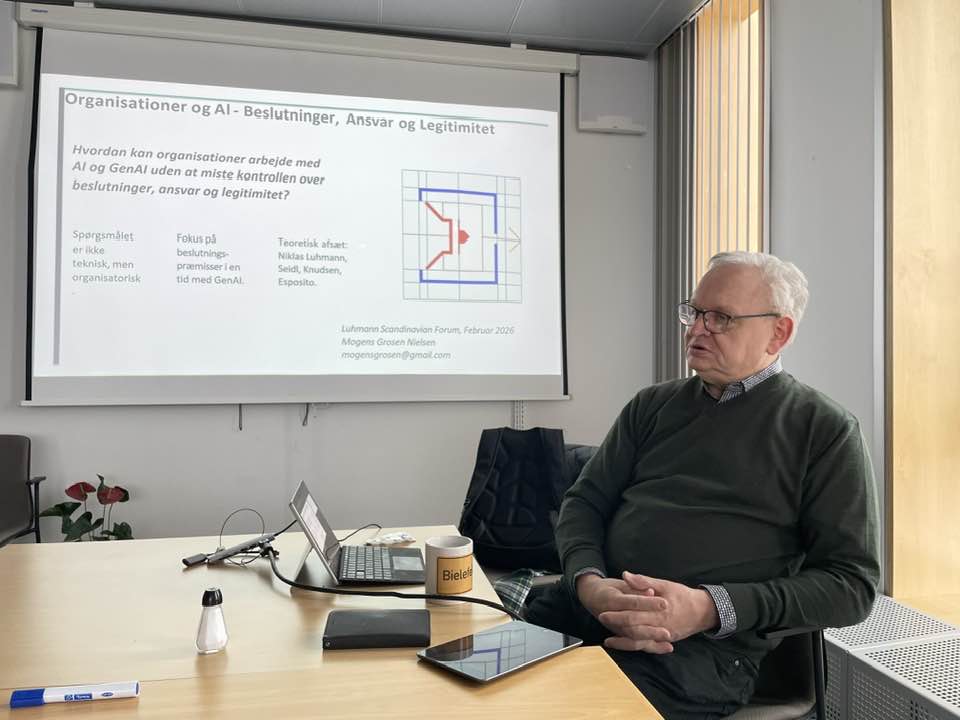
This was the starting point for my presentation at the Scandinavian Luhmann Forum at Aarhus University, 6 February 2026. My argument was that organisations do not lose control over AI in one dramatic moment.
They lose control gradually when AI outputs are treated as decisions without being translated into explicit responsibility, review procedures, stop rules and documentation.
In that sense, to “tame the algorithms” is not to reject AI. It is to make AI organisationally accountable.
The question is not only technical
How can organisations work with AI and GenAI without losing control over decisions, responsibility and legitimacy? This was the main question in my presentation at the Scandinavian Luhmann Forum at Aarhus University.
My central point was that AI is not first of all a technical issue. It is an organisational issue. GenAI can produce suggestions, drafts, classifications, explanations, summaries and risk assessments. However, AI does not decide in an organisational sense. A decision only becomes organisationally effective when it is connected to the organisation’s own decision premises. These decision premises include programmes, roles, communication channels and culture.
The hidden gap between AI strategy and daily decisions
Many organisations already have AI strategies, governance models, ethical principles, policies, risk frameworks and compliance procedures. However, there is often a premise gap between these frameworks and everyday operations.
On one side, organisations have strategies, regulation and formal governance. On the other side, they have daily production, deadline pressure, routines, local priorities, informal habits and silent assumptions. In practice, organisations often continue on autopilot. The formal AI policy may say one thing, while actual decisions are shaped by time pressure, existing routines and local interpretations of what “must be done”.
This is why the challenge is not simply to “implement AI”. The real challenge is to translate AI output into explicit decision premises that can guide later decisions.
The questions every organisation should ask
Every organisation working with AI should ask who is allowed to use AI output, who is responsible for the final decision, when AI output must be reviewed, who has the authority to interrupt or stop the process, what exceptions apply, how the final selection is documented, and how the decision can later be reconstructed, explained and challenged.
These questions are not bureaucratic details. They are the conditions for keeping responsibility inside the organisation.
GenAI is a proposal system — not a decision machine
GenAI should be understood as a proposal system. AI can create variation. It can produce alternative texts, analyses, classifications, risk descriptions and possible courses of action. This can be valuable because it expands the organisation’s room for reflection.
However, the organisation must still select, justify and stabilise the decision itself. Otherwise, AI output risks becoming a silent decision premise. The implicit rule becomes: “If the model says X, we do Y.” This is what I call silent conditionalisation.
Where responsibility begins to slip
The danger is not that AI produces suggestions. The danger arises when suggestions quietly become premises for action without mandate, review, exception handling or traceability.
At that point, responsibility begins to move. This movement may not be formal, but it can be practical. The organisation may still claim that humans are responsible, while the actual selection has already been shaped by a model output that no one really reviewed, questioned or translated into a proper decision rule.
Legitimacy requires more than compliance
This is also where legitimacy becomes fragile. Legitimacy cannot be reduced to saying: “We comply with the rules.” Policies, audits and risk frameworks are important. However, they can also become ceremonial if they do not change actual decision chains.
A more demanding legitimacy test is whether the organisation can explain a decision clearly to employees, clients, citizens, regulators and the public without hiding behind the model. The organisation should be able to show what AI contributed, what was selected, what was rejected, who decided, and why.
If it cannot do this, the problem is not only technical. It is a problem of decision premises.
A Luhmann-inspired view of AI in organisations
From a Luhmann-inspired perspective, organisations are not machines that simply execute plans. They are systems of decision communication. They reproduce themselves through chains of decisions. This means that AI only becomes organisationally relevant when it enters these decision chains as a premise for further decisions.
The practical task is therefore not to make AI “intelligent enough” to decide for the organisation. The task is to design organisational formats that keep AI at the level of variation and proposal. At the same time, these formats must require humans and organisations to translate relevant AI outputs into explicit programmes, roles, review procedures, stop rules, exceptions and documentation.
A new role for consultants, researchers and experts
This also changes the role of consultants, researchers and experts. Their task is not only to deliver models, recommendations and best practice. Such contributions often remain outside daily operations.
The more important task is to design observation formats where organisations can examine their own distinctions, blind spots and decision premises. In this sense, the key issue is not whether AI is good or bad. The key issue is how AI is coupled to organisational decision-making.
To tame algorithms is to preserve decision-making capacity
To “tame the algorithms” does not mean to stop AI. Nor does it mean to leave decisions to technology. It means maintaining the organisation’s own decision-making capacity.
For me, the central question is not how we get AI into the organisation. The central question is how we translate AI into decision premises, so that the organisation preserves responsibility, legitimacy and the ability to decide.
#AI #GenAI #Organisation #Luhmann #DecisionMaking #Governance #ResponsibleAI #DigitalTransformation #ArtificialIntelligence #OrganisationalChange #AIStrategy #DecisionPremises