'%3e%3cpath%20fill-rule='evenodd'%20clip-rule='evenodd'%20d='M4.78913%2017.7017C3.6351%2020.5765%203%2023.7147%203%2027C3%2038.9548%2011.4092%2048.9609%2022.63%2051.4209C24.36%2051.8001%2026.1568%2052%2028%2052C29.8431%2052%2031.64%2051.8001%2033.37%2051.4209C36.0675%2047.4302%2037.6433%2042.6203%2037.6433%2037.4453C37.6433%2035.4696%2037.4136%2033.547%2036.9795%2031.703C36.2821%2028.7405%2035.0571%2025.9806%2033.4093%2023.5281C34.0408%2024.5209%2034.4067%2025.6988%2034.4067%2026.9616C34.4067%2030.4972%2031.538%2033.368%2028.0033%2033.3715H27.9968H27.9873C24.827%2033.3715%2021.8029%2032.7839%2019.0184%2031.712C12.5509%2029.2223%207.37594%2024.1203%204.78913%2017.7017Z'%20fill='url(%23paint0_linear_331_327)'/%3e%3cpath%20fill-rule='evenodd'%20clip-rule='evenodd'%20d='M7.27324%2013.0244C6.28825%2014.4816%205.45281%2016.0481%204.78906%2017.7016C7.37588%2024.1203%2012.5509%2029.2223%2019.0183%2031.7119C21.8028%2032.7839%2024.8269%2033.3715%2027.9872%2033.3715C24.4538%2033.3664%2021.5867%2030.4961%2021.5867%2026.9616C21.5867%2025.7554%2021.9206%2024.6266%2022.5008%2023.6626C22.6297%2023.4486%2022.7706%2023.2427%2022.9228%2023.0459C24.3454%2021.0318%2026.0581%2019.2369%2027.9999%2017.7223C32.2388%2014.416%2037.5694%2012.4453%2043.3566%2012.4453C45.1998%2012.4453%2046.9966%2012.6452%2048.7266%2013.0244C44.2319%206.375%2036.6228%202%2027.9999%202C19.3771%202%2011.768%206.375%207.27324%2013.0244Z'%20fill='url(%23paint1_linear_331_327)'/%3e%3cpath%20fill-rule='evenodd'%20clip-rule='evenodd'%20d='M33.3699%2051.4209C44.5907%2048.9609%2052.9999%2038.9548%2052.9999%2027.0001C52.9999%2023.7026%2052.3602%2020.5534%2051.1981%2017.67C50.5364%2016.0281%2049.7053%2014.4724%2048.7266%2013.0245C46.9966%2012.6452%2045.1998%2012.4453%2043.3567%2012.4453C37.5694%2012.4453%2032.2388%2014.416%2027.9999%2017.7224C26.0581%2019.237%2024.3454%2021.0318%2022.9229%2023.0459C24.0956%2021.5291%2025.9329%2020.5517%2027.9967%2020.5517C30.1165%2020.5517%2031.9972%2021.5828%2033.1645%2023.1705C33.2499%2023.2868%2033.3316%2023.4061%2033.4092%2023.5281C35.0571%2025.9807%2036.282%2028.7405%2036.9794%2031.703C37.4136%2033.5471%2037.6432%2035.4696%2037.6432%2037.4453C37.6432%2042.6204%2036.0675%2047.4302%2033.3699%2051.4209Z'%20fill='url(%23paint2_linear_331_327)'/%3e%3c/g%3e%3cdefs%3e%3cfilter%20id='filter0_d_331_327'%20x='0'%20y='0'%20width='56'%20height='56'%20filterUnits='userSpaceOnUse'%20color-interpolation-filters='sRGB'%3e%3cfeFlood%20flood-opacity='0'%20result='BackgroundImageFix'/%3e%3cfeColorMatrix%20in='SourceAlpha'%20type='matrix'%20values='0%200%200%200%200%200%200%200%200%200%200%200%200%200%200%200%200%200%20127%200'%20result='hardAlpha'/%3e%3cfeOffset%20dy='1'/%3e%3cfeGaussianBlur%20stdDeviation='1.5'/%3e%3cfeComposite%20in2='hardAlpha'%20operator='out'/%3e%3cfeColorMatrix%20type='matrix'%20values='0%200%200%200%200%200%200%200%200%200%200%200%200%200%200%200%200%200%200.25%200'/%3e%3cfeBlend%20mode='normal'%20in2='BackgroundImageFix'%20result='effect1_dropShadow_331_327'/%3e%3cfeBlend%20mode='normal'%20in='SourceGraphic'%20in2='effect1_dropShadow_331_327'%20result='shape'/%3e%3c/filter%3e%3clinearGradient%20id='paint0_linear_331_327'%20x1='6.57855'%20y1='29.8278'%20x2='34.4067'%20y2='42.0556'%20gradientUnits='userSpaceOnUse'%3e%3cstop%20stop-color='%231E2E41'/%3e%3cstop%20offset='0.5'%20stop-color='%23235B82'/%3e%3cstop%20offset='1'%20stop-color='%23B4ECFF'/%3e%3c/linearGradient%3e%3clinearGradient%20id='paint1_linear_331_327'%20x1='41'%20y1='8'%20x2='13.0644'%20y2='24.2703'%20gradientUnits='userSpaceOnUse'%3e%3cstop%20stop-color='%231E2E41'%20stop-opacity='0.2'/%3e%3cstop%20offset='0.5'%20stop-color='%23235B82'/%3e%3cstop%20offset='1'%20stop-color='%23B4ECFF'/%3e%3c/linearGradient%3e%3clinearGradient%20id='paint2_linear_331_327'%20x1='39.9539'%20y1='47.5325'%20x2='40.9481'%20y2='17.6858'%20gradientUnits='userSpaceOnUse'%3e%3cstop%20stop-color='%231E2D40'/%3e%3cstop%20offset='0.5'%20stop-color='%23235B82'/%3e%3cstop%20offset='1'%20stop-color='%23B4ECFF'/%3e%3c/linearGradient%3e%3c/defs%3e%3c/svg%3e)
Introduction
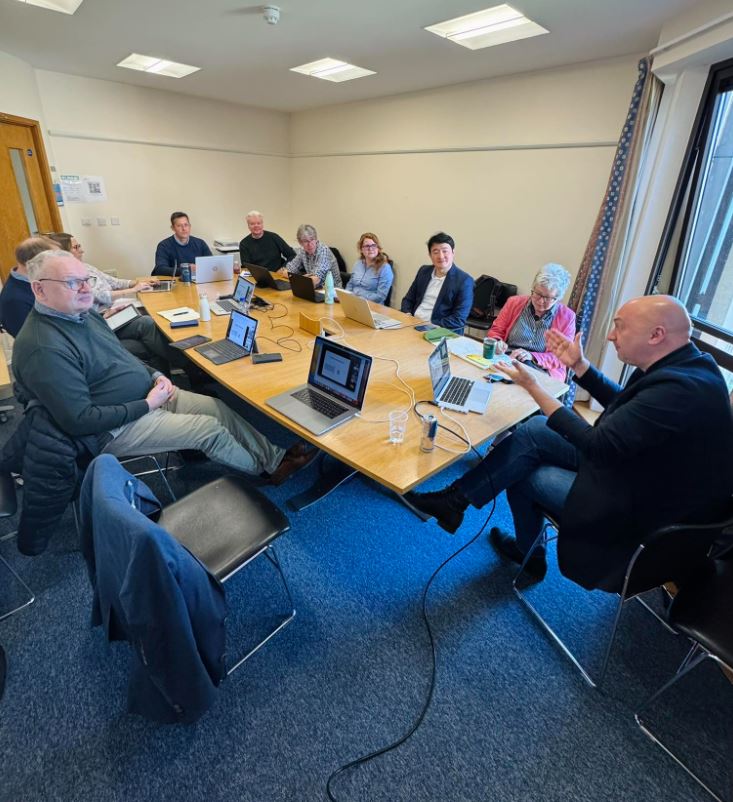
On 23 April 2026, I contributed at Wolfson College, Cambridge for the first-ever Wolfson Tool Factory meeting—an experimental workshop dedicated to the co-production of theory-based management and consulting tools.
Watch the video below for a non-theoretical overview. For theoretical details see this Cambridge publication.
The integration of generative AI into organizational decision-making is currently hampered by a "premise gap" — the weak translation of guidance and standards into communications that actually shape decisions.
This briefing outlines a repositioning of generative AI from a "neutral answer engine" to a "guided communication architecture" through the development of the AI-CATCH tool.
Main elements in a new approach
Rooted in Luhmannian systems theory and the epistemology of cognition as construction, the proposed approach argues that AI can only improve the speed and quality of decision processes under strict conditions. Key takeaways include:
- Problem Reconstruction: AI must be used to reconstruct how problems are observed rather than simply providing solutions to assumed issues.
- Procedural Legitimacy: Legitimacy is not a moral proclamation but a result of rigorous procedures, including review, contestation, and traceable approval.
- Decision Premises: AI-generated outputs only become organizationally consequential when translated into "decision premises" — rules or programs that can be cited in subsequent organizational operations.
- Functional Defensibility: Proposals must be tested across multiple "structural couplings," ensuring they are simultaneously defensible in terms of science, law, politics, and public communication.
Ultimately, the AI-CATCH tool aims to move organizations more quickly from "vague irritation" to "explicit, reviewable decision premises" without displacing human responsibility into opaque AI-generated plausibility.
1. Epistemological Foundation: Cognition as Construction
The core argument rests on the shift from "subject-object" thinking to "observation." In this framework, cognition is not a mirror of reality but a construction produced through distinctions.
Key Conceptual Distinctions
- Operation vs. Observation: Every observation is itself an operation that uses a distinction to make something visible while leaving something else unmarked (the "blind spot").
- First-Order vs. Second-Order Observation: Organizations can observe an issue, but they can also observe how they are observing that issue.
- Truth vs. Other Evaluative Forms: In organizations, truth is often less critical than legitimacy, legality, timeliness, and trustworthiness.
Implications for AI
AI output is treated as a "variation offer" or an "observation" rather than a factual answer. Because every observation creates blind spots, the value of AI lies in its ability to foster "second-order observation" — helping the organization reflect on its own descriptions and distinctions.
2. Organizational Theory: Autopoiesis and Decision Premises
Modern organizations reproduce themselves through chains of decisions. For AI to be effective, it must interface with the different levels of organizational "autopoiesis" (self-reproduction).
Levels of System Autopoiesis
| System Type | Reproductive Element | AI-CATCH Role |
|---|---|---|
| Psychic Systems | Consciousness / Irritation | Helps move from private irritation to precise problem formulation. |
| Interaction Systems | Situational Communication | Supports workshops and face-to-face comparison of observations. |
| Organization Systems | Decision Communications | Converts observations into reviewable "decision premises." |
| Function Systems | Binary Codes (Law, Science, etc.) | Ensures outputs are defensible across external constraints. |
The Role of Decision Premises
An AI-generated proposal only matters if it is translated into a decision premise. These premises — such as programs, roles, or communication channels — act as "stop-rules" or "exception procedures" that shape later decisions. Without this translation, AI outputs remain "ceremonial references" with no operational impact.
3. AI-CATCH: A Guided Communication Architecture
AI-CATCH is presented not as a "solution engine" but as a tool for "disciplined problem reconstruction." It is designed to prevent "naive implementation" by adhering to five core design principles.
Core Design Principles
- Problem Reconstruction before Solution Generation: The tool identifies the "guiding distinction" and constraints of a problem before suggesting actions.
- Blind-Spot Analysis: A formal step to identify what the current framing of a problem excludes.
- Functional Comparison: Generating several functionally equivalent options rather than one "best" answer.
- Persona-Specific Interaction: Tailoring communication for different roles (e.g., Solo Explorer, Reviewer, Approver).
- Reviewable Hand-over Outputs: Producing drafts that can be rejected, revised, or approved within organizational procedures.
4. Workflow and Persona Architecture
The AI-CATCH system facilitates a structured movement across system types through four distinct phases.
The Practical Workflow
- Phase 1 — Problem and Solution Analysis: Targeted at the "Solo Explorer," the system restates the issue, identifies missing information, and maps constraints.
- Phase 2 — Co-creation: Supports "Interaction Systems" (workshops) to articulate trade-offs and reformulate proposals.
- Phase 3 — Review: Drafts are tested for clarity and consistency. This is not about validating AI, but increasing "organisational selectability."
- Phase 4 — Approval: Condensing drafts into "decision briefs" or "checklists" that serve as premises for future work.
Persona Specifications
- Solo Explorer: Initial analysis and drafting (e.g., in the GSBPM "Specify Needs" phase).
- Stakeholder / Workshop Participant: Focuses on coupling with other parties, improving the initial draft.
- Reviewer / Approver: Focuses on preparing decisions and organizational responsibility.
- Platform Operator: Manages the curated knowledge base of standards and frameworks.
5. Standards as Source of Terminology and "Rules of the Game"
The document argues for a shift in how organizations view standards and frameworks (e.g., GSBPM, GAMSO, NQAF).
- Source of Terminology: Standards should not be treated as dogmatic checklists (e.g. quality), but as valuable sources that provide coherent terms to be integrated into daily work.
- Not Truth-Bearing Solutions: Standards should not be treated as dogmatic "answer keys."
- Rules of the Game: Like the rules of a football match, standards define what counts as an "acceptable move." They do not eliminate uncertainty but make coordinated play — and objection — possible.
- Premise Resources: Standards are most effective when used as resources to structure review points, thresholds, and exception handling.
6. Procedural Legitimacy and Structural Coupling
Legitimacy in a "functionally differentiated society" cannot be offloaded to an AI. It must be generated through procedures that neutralize motives and handle conflict.
Multifunctional Defensibility
AI-CATCH tests candidate outputs against "structural couplings" to ensure they satisfy the expectations of different function systems:
- Science: Methodological adequacy and scientific credibility.
- Law: Legal permissibility and confidentiality (items touching on "red-zones" like data use require documented legal review).
- Politics: Mandate compatibility and public visibility.
- Public Communication: Explainability and trust.
Transparency of Premises
Legitimacy requires that decision premises be made "public" to relevant parties. This means the guiding distinctions, compared alternatives, and invoked standards must be reconstructable and contestable.
7. Case Study: Labour Force Statistics Demo
A practical demonstration of the AI-CATCH "Solo Explorer" illustrates the transition from irritation to a defensible draft.
- The Initial Irritation: A team reports that the "quality unit does not help us... we need urgent change to improve timeliness to improve trust."
- Problem Reconstruction: The system identifies a "breakdown in the internal accountability chain" rather than just a "support deficit." It highlights a secondary "trust/distrust" layer.
- Blind-Spot Identification: The system reveals that focusing only on "timeliness" may overlook "methodological risks" (e.g., model-based estimation) that could damage trust more than a delay would.
- Structural Coupling Test: The system prompts for context on legal release schedules (Law) and public visibility (Politics).
- Functional Options:
- Option A: Emergency quality unit re-engagement protocol (formalizes minimum involvement).
- Option B: Process diagnostic and targeted redesign (maps GSBPM bottlenecks).
- Output: A recommended solution that addresses high legal obligations and high methodology risks through parallel actions, providing a "methodology sign-off record."
8. Conclusion: Redefining "Better and Faster"
The term "better and faster decision processes" is redefined within this framework:
- Better: Does not mean "objectively optimal" but rather "procedurally defensible" and "multifunctionally tested."
- Faster: Does not mean "less reflective" but rather a "quicker movement from vague irritation to explicit, reviewable decision premises."
The AI-CATCH design logic demonstrates that generative AI contributes to organizations only when it is embedded in procedures that preserve human responsibility, second-order observation, and public reconstructability. Without these conditions, AI risks being reduced to a generator of hidden, unreviewable premises.
About the author
Mogens Grosen Nielsen
Independent consultant with 30+ years of experience working at Statistics Denmark and advising statistical organisations across Europe, Africa, Asia, Latin America and the Middle East. Focus: quality, metadata, and AI-assisted change in official statistics.